My work on Docker grew out of earlier work on MirageOS, OCaml and the
Xapi / Xen toolstack. We explored how to build systems from reusable,
type-safe libraries: network protocols, storage and the machinery for managing VMs.
The timeline includes both the papers and the code, back to Melange in 2007.
We used our systems background (and unikernel libraries) to create a seamless "Docker for Mac"
and "Docker for Windows" experience.
Later the same code evolved into a platform for running containers and AI agents in microVMs
and is used across the Docker product suite.
Here's a list of some of the things I've worked on, newest first.
Almost all of it was done with other people, so where I can I've linked to
the code, the blog posts and the papers.
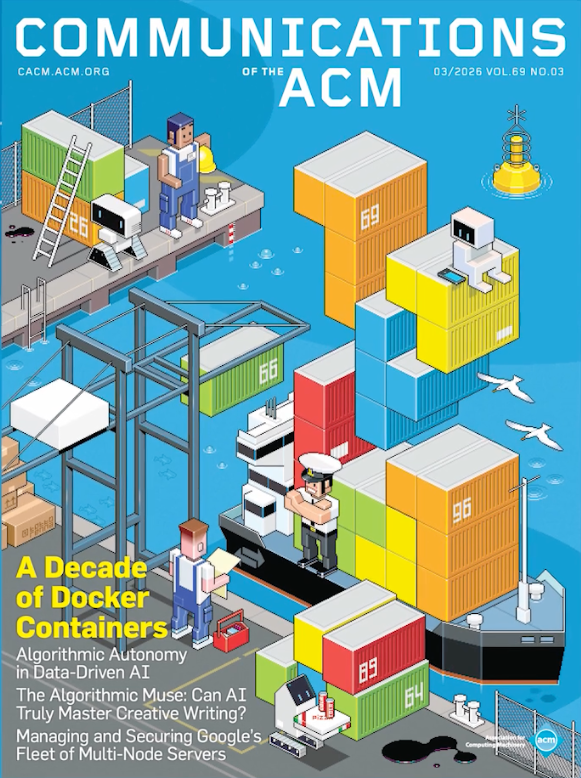
2026-03: A Decade of Docker Containers (CACM cover article)
papers & talks
Anil Madhavapeddy,
Justin Cormack and I wrote up how Docker
got from Linux to Mac and Windows, the systems research underneath it, and where things are
heading with coding agents. The ACM made a nice video and cover art!
Agents need to run somewhere where access to the outside is carefully controlled
i.e. a "sandbox".
The unikernel derived VMM tech used in Docker Desktop is now also the isolation layer in
Docker Sandboxes, now enhanced with ultra-fast networking and support for running GUIs safely
inside the VMs.
2025-10: Functional Networking for Millions of Docker Desktops (ICFP)
networkingpapers & talks
An experience report on ten years of running an OCaml, unikernel-inspired network stack
on millions of developer machines: what worked, what didn't and what we'd do again.
Written with
Anil Madhavapeddy,
Patrick Ferris,
Ryan Gibb
and
Thomas Gazagnaire;
Anil gave the talk.
Our 2013 Unikernels paper won one of the ASPLOS Influential Paper Awards.
The Mirage OS libraries from that work are the same ones that ended up inside Docker Desktop.
Although Apple's virtualization.framework is a great general-purpose VMM,
there are various ways to optimize specifically for Linux containers.
Therefore we created Docker VMM using Apple's lower-level hypervisor.framework,
built using a fork of
the excellent
libkrun project.
Filesharing perf improved to the point where
a directory search over virtiofs would be "faster than native macOS"
if caches are warm. We shipped Docker VMM
as a beta in Desktop 4.35.
In the cloud people often talk about "scaling to zero". I've always
been a fan of the principle that your laptop should only be executing code if
you actually tell it to, i.e. definitely no battery reducing background polling loops.
I built a mechanism for shutting down the Docker Desktop helper VM, keeping it offline
as much as possible (e.g. by not booting it up for read API requests) and starting
it on demand to actually run containers.
I originally switched Docker from kernel networking to a custom userspace
stack
vpnkit (based on the Mirage unikernel libraries)
to work around OS security issues and to allow us to interoperate more easily
with corporate firewalls and VPNs.
Now it was time to switch Mac again to a
google/gvisor-based solution.
In our published
iperf3 benchmark on a first-generation M1 Mac Mini, throughput went
from about 3.5 to 19 Gbit/s — over five times faster.
Kubernetes was built on top of Docker, but in 2022 the method of talking to Docker was changing.
Various misleading headlines saying alarming things like
"Kubernetes is deprecating Docker" started appearing so we needed to act quickly.
To ensure zero hassle for our users, I migrated Desktop's Kubernetes integration to
cri-dockerd. This migration shipped in Desktop 4.7.0.
To explain what this all means properly I blogged about it in an April article
ahead of Kubernetes 1.24.
Enterprises often have sophisticated HTTP proxy setups, especially if they operate worldwide.
Originally Docker Desktop's handling of HTTP proxies was fragmented, each component
doing its own thing.
A customer told us the obvious truth, that proxy configuration should be "one and done", not something
that needs per-component consideration.
I consoliated all proxy handling across the product so every subcomponent behaved
identically, irrespective of programming language, and all supported the same feature set. Previously for example one component
would support PAC files proxy auth, while another relied on Unix-style environment variables.
2022-01-25: How Docker Desktop Networking works under the hood
networkingenterprisepapers & talks
A common topic when speaking with customers is how exactly Docker Desktop's networking works
and how well will it interop with other network products.
I wrote a detailed blog post all
about the unikernel-inspired userspace networking stack that connects containers to
the outside world in Docker Desktop.
Later this work was refined and used by Valentin and Julius from CARIAD to produce a white paper.
Businesses want to control which registries their developers can pull from.
Inspired by
Cilium
I defined a network policy and then built an enforcement mechanism
using a combination of DNS + eBPF + cgroup hooks.
We shipped the GA version of Apple Silicon support! In the meantime Apple had published
a nice higher-level VMM API called virtualization.framework
which we intended to become our default. So I added support for this too and it shipped as an experimental
choice, while QEMU remained the default.
2020-11-29: Early build demonstrates incoming Apple Silicon support
VMs & platforms
The first M1 Macs arrived and Docker didn't run on them yet. I put together the
early preview builds: integrating the engine and CLI, fixing startup problems and
iterating until the tech preview shipped in December, immediately after the hardware itself shipped.
My screenshot of an early
build ended up in an AppleInsider post by Malcolm Owen.
After Windows, I brought the gRPC-FUSE file-sharing implementation to the Mac as
the default, reducing file-event CPU overhead and allowing shared paths to change
without restarting the VM. It shipped as the default in Docker Desktop 2.4.0.0
on 30 September.
I also implemented virtio-blk DISCARD in hyperkit so deleted data could be
given back to the host.
2019-12-12: New file sharing implementation in Docker Desktop for Windows
networkingfile sharingpapers & talks
We replaced Samba with FUSE over gRPC over Hyper-V sockets. It's much faster, and file
change notifications finally work, so tools that watch for edits (like hot reload)
behave properly. I implemented the inotify event injection and spent a lot of time
on filesystem semantics and caching. The deep dive explains how it all fits together.
I changed Docker Desktop's Windows DNS handling to use the native
APIs. Using Windows' own resolver instead of reimplementing
its behaviour meant Docker followed the same DNS and VPN rules as other
Windows applications.
Kubernetes on Windows
networkingVMs & platforms
Docker for Windows gained Kubernetes. I worked on networking for it, and looked at how to
change the VM's IP address without forcing everyone to reset their cluster.
Added pluggable logging to LinuxKit, building on Magnus Skjegstad's earlier work, and taught
vpnkit to forward Unix sockets and Windows named pipes, including connections to
services such as the Docker socket.
I added HTTP proxy modes for networks where only the proxy could resolve DNS,
with CONNECT support for TLS traffic and tests for the different request paths.
I also built more realistic HTTP proxy tests using host firewalls.
Two hyperkit instances writing to the same disk file is a recipe for corruption.
I added locking on the backing file, replacing a fragile separate lock file, and added
TRIM for sparse raw disks.
I implemented online qcow2 compaction so Docker could return disk space without
a restart, enabled it by default, and later used sparse raw disks where APFS made
the simpler approach possible. Building on TRIM support from late 2016, the OCaml
algorithm recycles clusters in the background while the VM keeps running.
I introduced docker.for.mac.localhost and
docker.for.win.localhost so containers could reach services on the
host without hard-coded IP addresses. These were precursors to the later
host.docker.internal name.
2016
vpnkit
2016-09-20: CVE-2016-4739 in macOS Sierra
networking
With Magnus Skjegstad and
Anil Madhavapeddy I found that apps using
VMnet.framework could end up with a DNS proxy listening on all network interfaces.
Apple fixed it in macOS Sierra and credited us.
2016-01-27: A userspace network stack for Docker for Mac
networking
Lots of early users had VPNs, and VPNs didn't get along with the VM's networking.
So I plugged the Mirage OCaml TCP/IP stack into Docker for Mac: Ethernet frames from
the VM are turned into ordinary socket calls on the Mac, so as far as the VPN is concerned
it's just another app. On 2016-04-18 it became the default. It was open-sourced as
vpnkit in May, and I merged the Mac and Windows frontends (using Hyper-V sockets on Windows)
in July.
Docker for Mac started as Project Piñata, a skunkworks project to bring
Docker to more developers. In a 2018 retrospective, Solomon Hykes described
it as Docker's first use of unikernel technology and its first collaboration
between Paris, Cambridge and San Francisco.
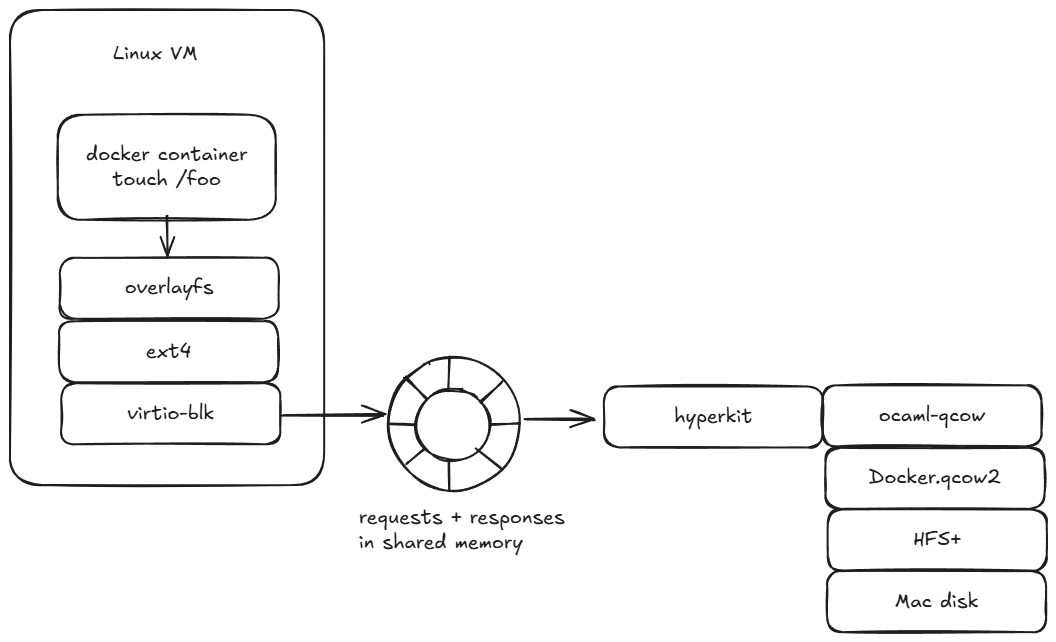
I integrated the Mirage qcow2 block layer into Docker for Mac's VM, giving
containers a disk that grew as needed instead of reserving its full size on the
laptop. This provided sparse storage even on HFS+, which lacked sparse-file
support, and let us offer a thin-provisioned 64 GiB container disk.
I integrated Irmin into Docker for Mac to store the VM's configuration, using
transactions, snapshots and watches to react to changes. Configuration became
versioned data: committing a new memory setting made the VM exit and pick up the change
on its next start.
Alongside this, I debugged alpha builds and worked out how diagnostics reports
should work. Early changes fixed symlinks in shared folders and kept the VM's
clock in sync with the host. That code now lives in the LinuxKit repo.
2015-05: Jitsu: Just-In-Time Summoning of Unikernels (NSDI)
networkingVMs & platformspapers & talks
With the Jitsu team, I co-authored a paper on starting small MirageOS unikernels in
response to network traffic on Xen/ARM. Shared-memory communication and connection
hand-off let services start on demand while masking boot latency. In January I also
proposed a simpler Jitsu backend using libxl directly; that PR was an RFC.
2015-02 to 03: Journalled storage with Mirage block libraries
storage
I exposed LVM logical volumes as Mirage BLOCK devices and added a transparent redo
log to mirage-block-volume. Alongside this, I worked on shared-block-ring
suspend/resume and modelled the queue protocol in Promela to reason about
synchronising storage updates.
I added Xapi to the Xen ARM builder, so hosts could upload and run VMs through
XenAPI and xe, collect performance metrics, and use thin-provisioned LVM storage.
Xapi could run alongside xl and libvirt on the same host.
2015-01-31: Choosing entropy sources for Mirage on Xen
VMs & platforms
I added separate choices for the strongest available Xen entropy source and a weak
source for development and experiments. This made the choice explicit in the
unikernel configuration.
2014-09-14: Packaging the Xapi toolstack with opam
VMs & platforms
I submitted the Xapi toolstack and its supporting libraries and services to the main
opam repository, making the OCaml components available through the same package
manager as the wider ecosystem.
2014-08 to 09: Deploying and connecting Mirage unikernels
VMs & platformsnetworking
I taught Mirage to generate a .xe script to upload a unikernel to a host running
Xapi, using xe-unikernel-upload. I also made the shared-memory vchan implementation
easier to test by functorising its environmental dependencies and adding Unix tests.
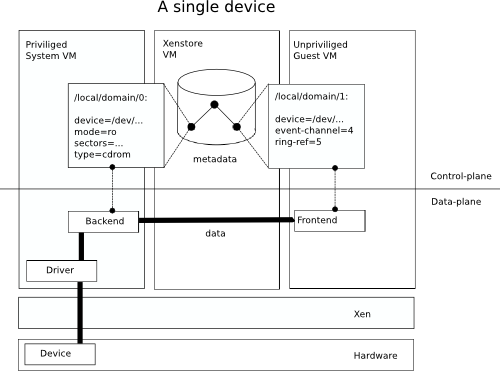
I built a Xenstore prototype using Irmin for transactions and persistence. It
recorded both the database and connection state, allowing the server to recover
after a restart while VMs kept running. The history could be inspected with git log,
and Irmin could merge independent device-configuration transactions without forcing
clients to retry. I described the design in a Mirage blog post and the Xenstore TNG
talk.
2014-02-01: Indirect descriptors for Xen block I/O
storage
I added an initial implementation of indirect descriptors to the Mirage Xen block
driver, extending the way block requests could describe their buffers.
2014-01: Unikernels: The Rise of the Virtual Library Operating System (CACM)
VMs & platformspapers & talks
Anil Madhavapeddy and I wrote a broader overview of unikernels for Communications of
the ACM, explaining the library OS approach and the ideas behind MirageOS.
I worked on the FAT filesystem and Unix/Xen block interfaces, including adding files
to FAT images and implementing the common Mirage BLOCK signature in the Xen driver.
These libraries let storage code run across different backends.
2013-09: Xen event delivery without periodic polling
VMs & platforms
I changed the Mirage Xen runtime to use asynchronous hypervisor callbacks and event-
channel counters. Waiting threads could block and resume without missing
notifications, with a timer interrupt handling timeouts.
2013-03: Unikernels: Library Operating Systems for the Cloud (ASPLOS)
VMs & platformsnetworkingpapers & talks
With the Mirage team, I co-authored the paper describing how to compile an OCaml
application and the libraries it needs into a small, specialised VM image running
directly on a hypervisor. We evaluated network services built this way. The paper
later received an ASPLOS Influential Paper Award in 2025.
2012-09-04: Infrastructure for a Xenstore stub domain
VMs & platforms
I added Xen infrastructure for running Xenstore in a stub domain: a small VM
separate from the host control domain. Grant-reference mapping also provided
building blocks for device backends and proxies.
I added multi-page rings and batched requests to the block performance test. On my
test storage, this reached about 770 MiB/s for random reads in 512 KiB blocks.
2011-08-10: Memory accounting in the Xen toolstack
VMs & platforms
I fixed a memory-management problem in the
memory ballooning daemon that could leak host memory when VMs
had no balloon drivers, part of the ongoing work on XenServer VM management.
I improved Mirage's XCP deployment script to use the xe remote API directly,
discover the running VM's UUID from Xenstore, and query block-device information
instead of relying on a lookup table.
2010-09: Using Functional Programming within an Industrial Product Group: Perspectives and Perceptions (ICFP)
VMs & platformspapers & talks
Richard Sharp, Thomas Gazagnaire, Anil Madhavapeddy and I reported on using OCaml to
build XenServer. We discussed the engineering experience as well as hiring,
collaboration and the reactions to using a less mainstream language in a large
product team.
2007-03: Melange: Creating a “Functional” Internet (EuroSys)
networkingpapers & talks
With Anil Madhavapeddy, Alex Ho, Tim Deegan and Ripduman Sohan, I co-authored the
Melange paper. We combined OCaml's static typing with generated packet-handling code
to build SSH and DNS servers, exploring how type-safe network services could perform
competitively with existing C implementations. The work was a precursor to MirageOS.